Gemma 詳解:PaliGemma 架構
Note
最初發表於 Google Developers 部落格。
在「Gemma 詳解」系列的上一篇文章中,你複習了 RecurrentGemma 架構。在這篇部落格文章中,你將探索 PaliGemma 架構。讓我們深入了解!
PaliGemma 3B
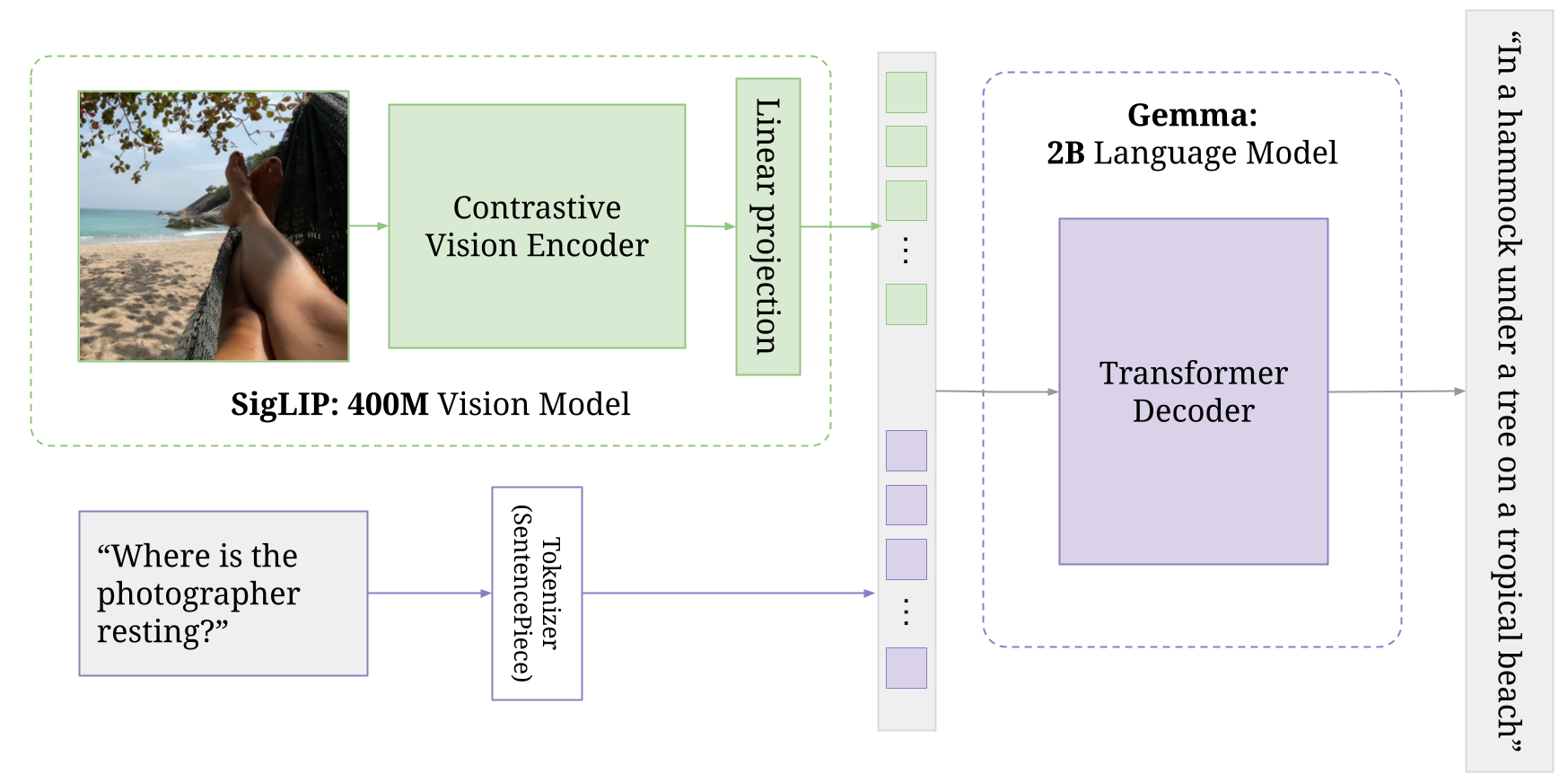
PaliGemma 是一個輕量的開放視覺語言模型(VLM),靈感來自 PaLI-3,並基於開放元件打造,如 SigLIP 視覺模型與 Gemma 語言模型。Pali 是 Pathway Language and Image Model(路徑語言與影像模型)的縮寫。如其名所示,這個模型能同時接受影像與文字輸入並產生文字回應,如本微調指南所示。
PaliGemma 架構
PaliGemma 在 BaseGemma 模型之上增加了一個由影像編碼器組成的視覺模型。這個編碼器連同文字詞元一起傳遞給一個專門化的 Gemma 2B 模型。視覺模型與 Gemma 模型都經過多個階段的獨立訓練與聯合訓練,以產出最終的聯合架構。完整細節請參閱 Pali-3 論文的第 3.2 節。
PaliGemmaForConditionalGeneration(
  (vision_tower): SiglipVisionModel(
    (vision_model): SiglipVisionTransformer(
      (embeddings): SiglipVisionEmbeddings(
        (patch_embedding): Conv2d(3, 1152, kernel_size=(14, 14), stride=(14, 14), padding=valid)
        (position_embedding): Embedding(256, 1152)
      )
      (encoder): SiglipEncoder(
        (layers): ModuleList(
          (0-26): 27 x SiglipEncoderLayer(
            (self_attn): SiglipAttention(
              (k_proj): Linear(in_features=1152, out_features=1152, bias=True)
              (v_proj): Linear(in_features=1152, out_features=1152, bias=True)
              (q_proj): Linear(in_features=1152, out_features=1152, bias=True)
              (out_proj): Linear(in_features=1152, out_features=1152, bias=True)
            )
            (layer_norm1): LayerNorm((1152,), eps=1e-06, elementwise_affine=True)
            (mlp): SiglipMLP(
              (activation_fn): PytorchGELUTanh()
              (fc1): Linear(in_features=1152, out_features=4304, bias=True)
              (fc2): Linear(in_features=4304, out_features=1152, bias=True)
            )
            (layer_norm2): LayerNorm((1152,), eps=1e-06, elementwise_affine=True)
          )
        )
      )
      (post_layernorm): LayerNorm((1152,), eps=1e-06, elementwise_affine=True)
    )
  )
  (multi_modal_projector): PaliGemmaMultiModalProjector(
    (linear): Linear(in_features=1152, out_features=2048, bias=True)
  )
  (language_model): GemmaForCausalLM(
    (model): GemmaModel(
      (embed_tokens): Embedding(257216, 2048, padding_idx=0)
      (layers): ModuleList(
        (0-17): 18 x GemmaDecoderLayer(
          (self_attn): GemmaSdpaAttention(
            (q_proj): Linear(in_features=2048, out_features=2048, bias=False)
            (k_proj): Linear(in_features=2048, out_features=256, bias=False)
            (v_proj): Linear(in_features=2048, out_features=256, bias=False)
            (o_proj): Linear(in_features=2048, out_features=2048, bias=False)
            (rotary_emb): GemmaRotaryEmbedding()
          )
          (mlp): GemmaMLP(
            (gate_proj): Linear(in_features=2048, out_features=16384, bias=False)
            (up_proj): Linear(in_features=2048, out_features=16384, bias=False)
            (down_proj): Linear(in_features=16384, out_features=2048, bias=False)
            (act_fn): PytorchGELUTanh()
          )
          (input_layernorm): GemmaRMSNorm()
          (post_attention_layernorm): GemmaRMSNorm()
        )
      )
      (norm): GemmaRMSNorm()
    )
    (lm_head): Linear(in_features=2048, out_features=257216, bias=False)
  )
)
vision_tower(SiglipVisionModel)
這個元件負責處理輸入影像。
它使用 SiglipVisionTransformer,這是一種為視覺任務設計的 Transformer 架構。
embeddings(SiglipVisionEmbeddings)
PaliGemma 接受一張或多張影像作為輸入,SigLIP 編碼器會將它們轉換成「軟詞元」(soft tokens)。
它將影像切成較小的區塊,就像文字模型處理句子中的單字一樣。模型接著學會捕捉這些區塊之間的關係,從而有效理解影像的視覺內容。
patch_embedding
它使用卷積層(Conv2d),參數如下。
-
3:輸入有 3 個通道(RGB 影像)
-
1152:輸出有 1152 個通道,即每個區塊的嵌入維度
-
kernel_size=(14, 14):每個區塊是 14x14 像素的正方形
-
stride=(14, 14):各區塊互不重疊(卷積濾波器每次移動 14 像素)
-
padding=’valid’:不套用填充,因此輸出尺寸會小於輸入尺寸。
position_embedding
每個區塊嵌入都會加上位置嵌入,用來編碼空間資訊(即每個區塊在原始影像中的位置)。
這是透過一個可學習的嵌入層(Embedding)完成的:它接受每個區塊的位置(最多 256 個位置)作為輸入,並輸出一個 1152 維的向量(與區塊嵌入維度相同)。
encoder(SiglipEncoder)
嵌入會經過一系列 SiglipEncoderLayer,每層都包含自注意力與前饋神經網路。這幫助模型捕捉影像不同部分之間的關係。
multi_modal_projector(PaliGemmaMultiModalProjector)
這個元件將視覺塔的輸出投影到多模態空間。這透過一個簡單的線性層實現,讓視覺與語言表示能有效結合。
language_model(GemmaForCausalLM)
這個元件是基於 Gemma 2B 模型的語言模型。
它接受來自投影器的多模態表示作為輸入,並生成文字輸出。
對於文字輸入,每個檢查點以不同的序列長度訓練。例如,paligemma-3b-mix-224 以序列長度 256 訓練(輸入文字 + 由 Gemma 分詞器分詞的輸出文字)。
PaliGemma 使用有 256000 個詞元的 Gemma 分詞器,但擴展了詞彙表:新增 1024 個代表正規化影像空間中座標的詞條(
物件分割範例
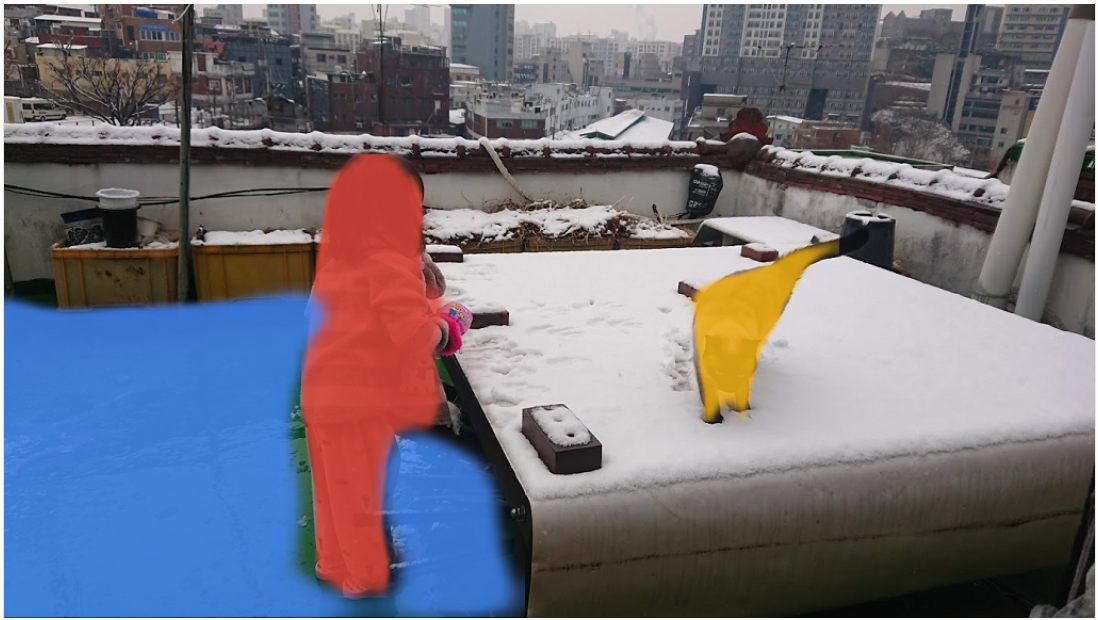
額外的軟詞元負責編碼物件偵測與影像分割。以下是 paligemma-3b-mix-224 的範例輸出。你可以到 HuggingFace 線上示範親自試試。

使用提示詞「segment floor;cat;person;」的 PaliGemma 輸出
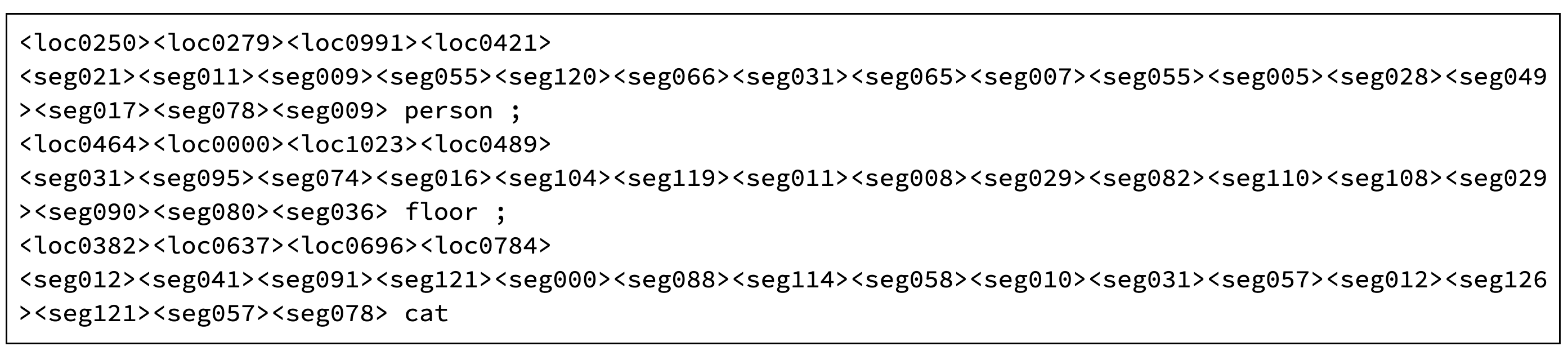
如果你不熟悉 ML 與電腦視覺任務,模型的輸出可能不太直覺、難以解讀。
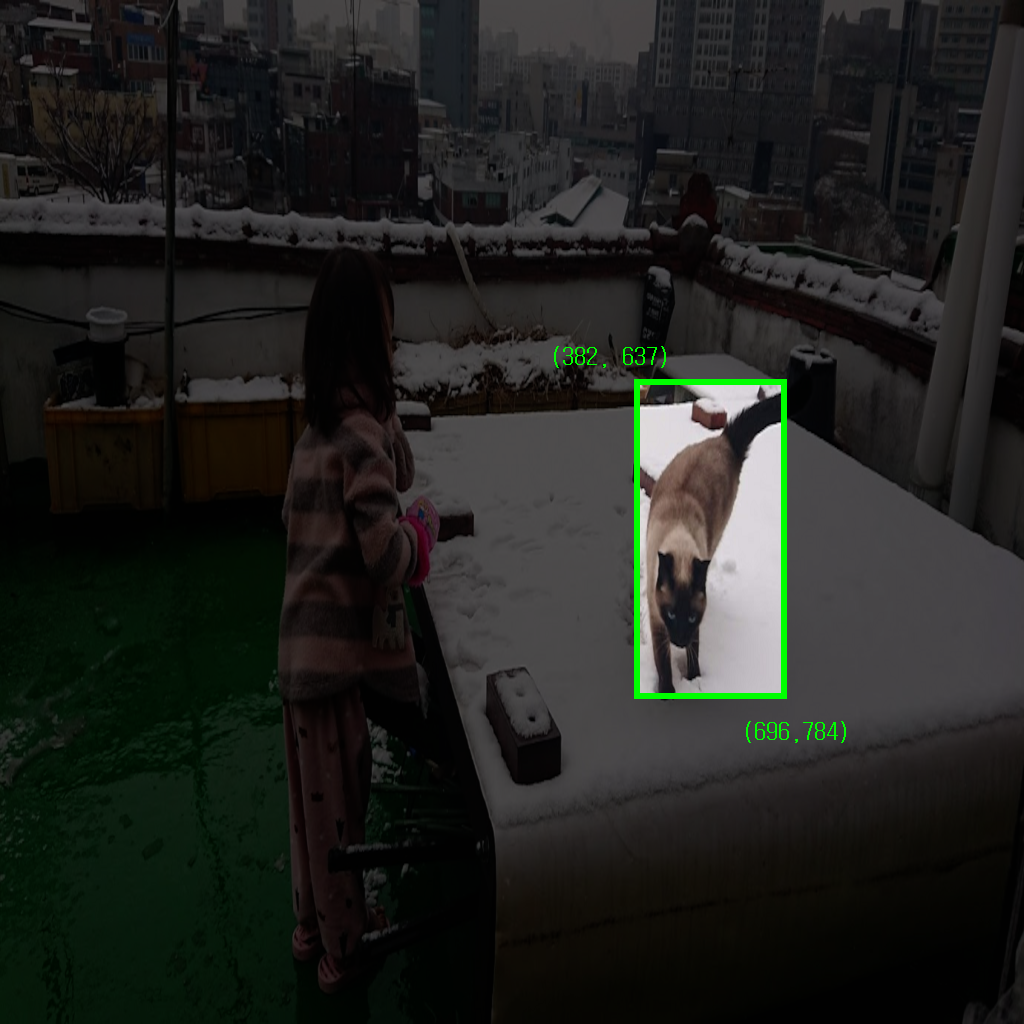
最初的四個位置詞元代表邊界框的座標,範圍從 0 到 1023。由於假設影像已縮放到 1024 x 1024,這些座標與長寬比無關。
例如,輸出顯示貓的位置位於座標 (382, 637) 與 (696, 784) 之間。在這個座標系統中,左上角記為 (0,0),且垂直座標列在水平座標之前。
遮罩由以下 16 個分割詞元編碼。神經網路模型(VQ-VAE)可以透過解碼這些值,從量化表示(碼本索引)重建遮罩。你可以從這裡探索實際程式碼。
最後,你可以從 PaliGemma 的輸出得到這個漂亮的成果。
總結
在這篇文章中,你認識了 PaliGemma。
Gemma 家族提供了理解現代大型語言模型系統的獨特機會:它是一系列擁有相似核心架構、但為不同使用場景設計的開放權重模型。這些由 Google 釋出給研究人員、開發者與終端使用者的模型,涵蓋了各種功能與複雜度。
希望這篇總覽能讓你簡潔地理解 Gemma 模型家族,並突顯其多功能性與適用於各種任務的特性。
Google Developer Community Discord 伺服器是展示專案、與開發者同好建立連結、參與互動討論的絕佳平台。歡迎加入伺服器,探索這些令人興奮的機會。
感謝閱讀!