Gemma 詳解:RecurrentGemma 架構
Note
最初發表於 Google Developers 部落格。

在「Gemma 詳解」系列的上一篇文章中,我們討論了最新的 Gemma 2 架構。在這篇文章中,你將探索 RecurrentGemma 架構。讓我們開始吧!
RecurrentGemma 2B, 9B
RecurrentGemma 基於 Griffin,這是一個混合模型,結合了門控線性遞迴與區域滑動視窗注意力。這種改變改善了運算與記憶體效率,更適合長上下文提示。
然而,由於 Griffin 架構的狀態大小固定,它在「大海撈針」(needle-in-a-haystack)測試中的效能有所下降。雖然可以將整本書的文字作為輸入提供給模型,但這種做法未必是最佳的。遞迴神經網路(RNN)在極長序列中學習長程依賴時可能遇到困難,且模型的上下文視窗有限。這表示它在做預測時,只能有效考慮一定數量的前文詞元。
此外,與 Transformer 相比,遞迴模型在推論時間最佳化方面尚未受到同等關注。相較於成熟的 Transformer 架構,可用的研究與社群支援也較少。
因此,當你擔心 LLM 的上下文視窗被耗盡時,這個模型會非常有價值。透過優先保留最新資訊並策略性地捨棄舊資料,RecurrentGemma 確保隨著上下文擴大,LLM 的效能依然強勁。
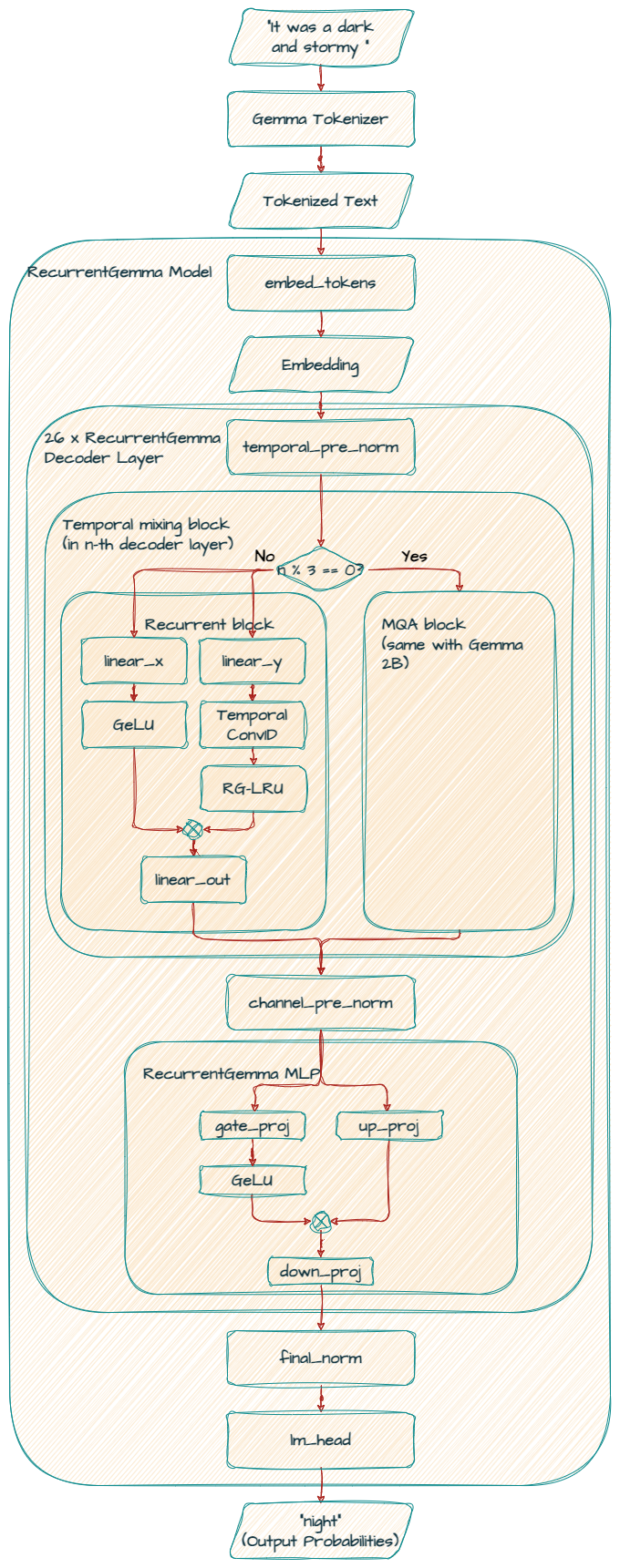
以下是 Recurrent Gemma 2B 模型的架構圖。
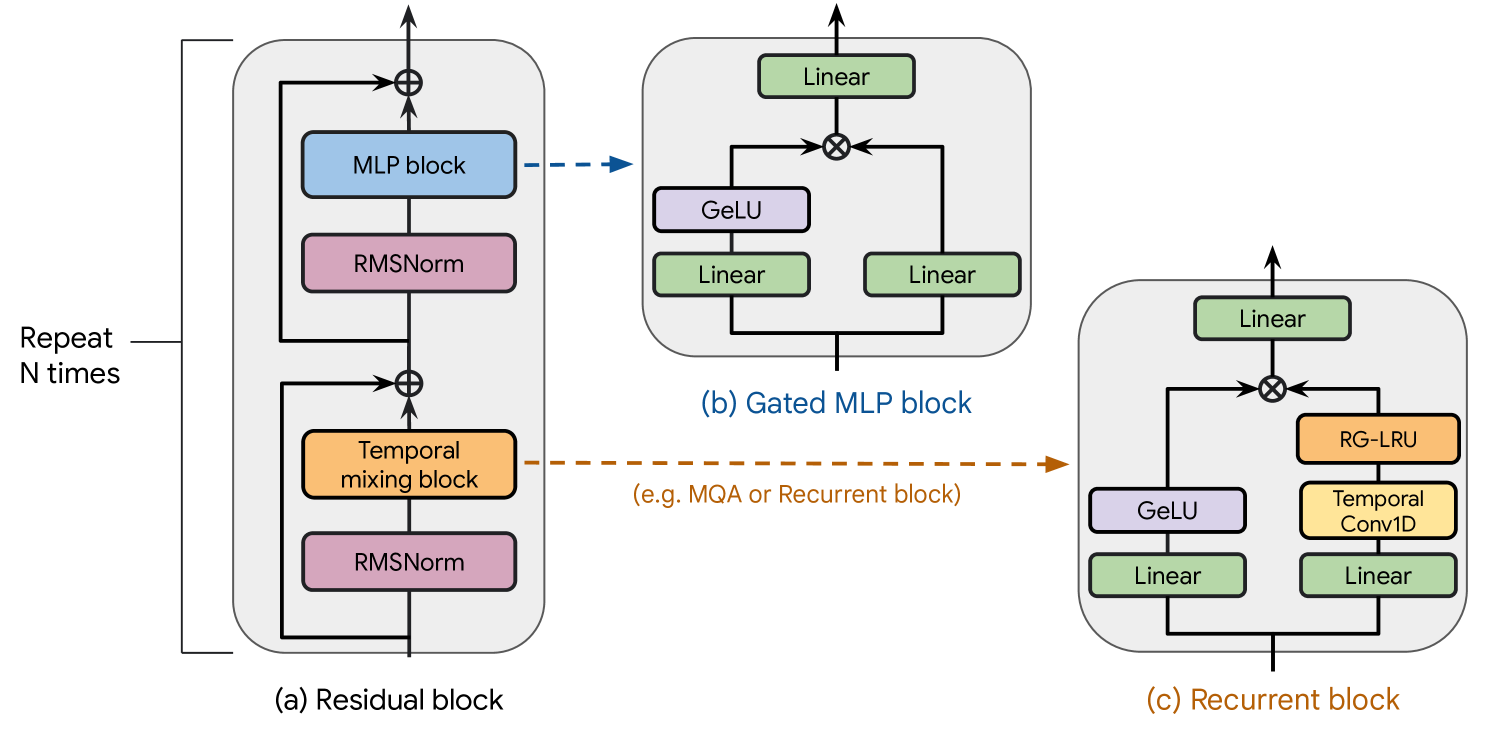
Griffin 遵循與其他 Transformer 基準模型相同的殘差模式與 MLP 區塊。然而,不同於 MQA Transformer 基準模型與 Hawk 模型,Griffin 混合使用了遞迴區塊與 MQA 區塊。
Griffin 採用分層結構:以兩個含遞迴區塊的殘差區塊交替排列,接著是一個包含區域 MQA 注意力區塊的殘差區塊。
架構的核心參數摘要於下表。
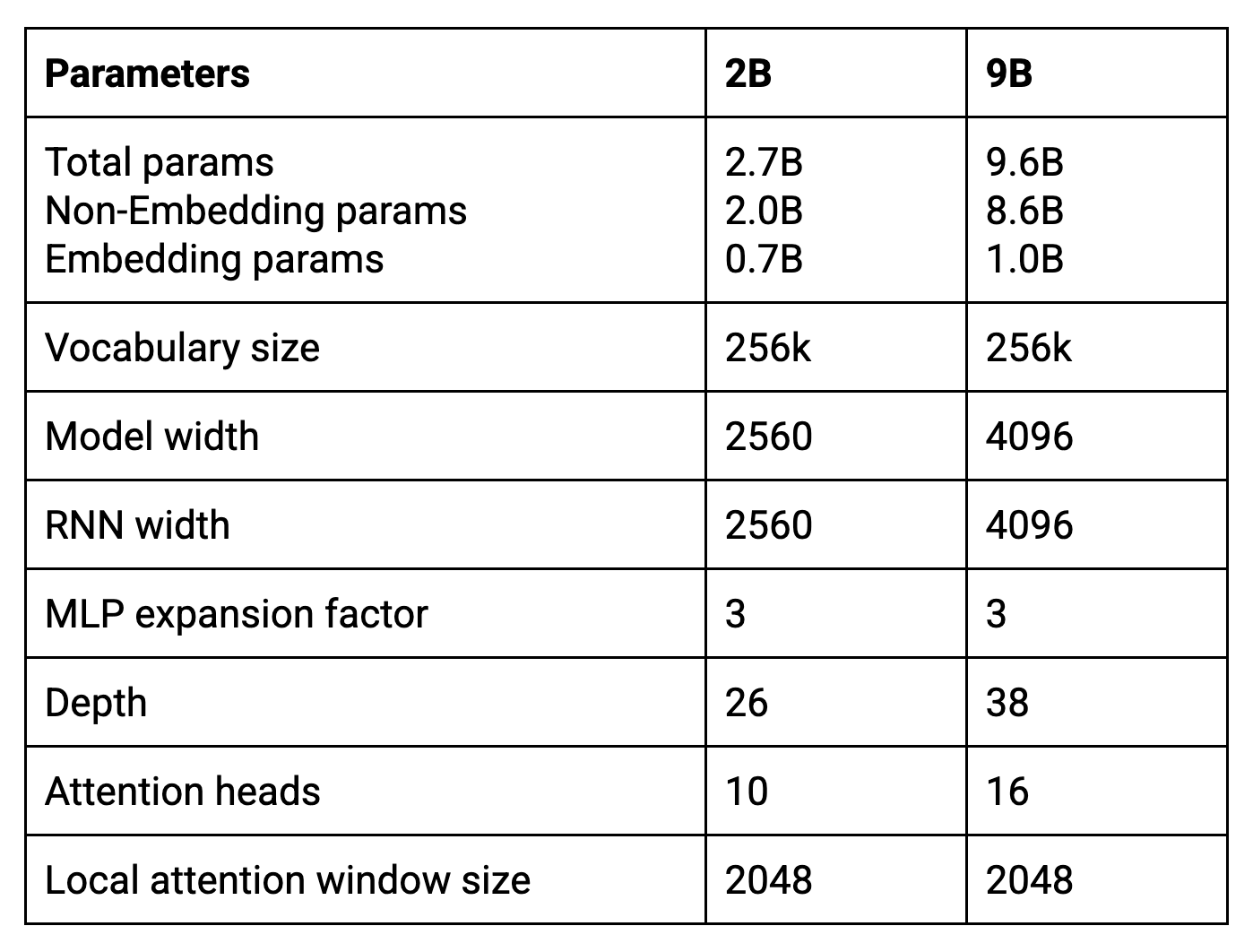
非嵌入參數與嵌入參數(Non-Embedding params and Embedding params)
非嵌入參數分布於模型的隱藏層中,例如注意力機制與前饋網路等元件。
注意:模型名稱「2B」來自這個參數。
嵌入參數通常位於稱為嵌入層的專用層中。這一層負責將離散的詞元(如單字或字元)映射為連續的向量表示(嵌入)。
注意:0.7B 可計算為 256k(詞彙表大小)x 2560(模型寬度)。
模型寬度與 RNN 寬度(Model width and RNN width)
模型寬度指的是模型隱藏層的大小,決定了模型表示複雜模式的能力,就像基礎的 Gemma 模型一樣。
遞迴神經網路(RNN)寬度是 Real-Gated Linear Recurrent Unit(RG-LRU)所維護的隱藏狀態大小。與傳統 Transformer 不同,遞迴區塊維護一個固定大小的內部狀態,不隨輸入長度變化。這讓 RecurrentGemma 能以更少的記憶體處理更長的序列,在生成長篇文章或程式碼等任務上更有效率。
MLP 擴展因子(MLP expansion factor)
它與基礎 Gemma 模型中的前饋隱藏層維度相同。為求簡潔,我們在 Recurrent Gemma 模型中套用了 3 的擴展因子,得到 MLP 維度為 7680(由 2560 x 3 計算而得)。
區域注意力視窗大小(Local attention window size)
RecurrentGemma 維護的狀態大小有限,不會隨超過 2k 詞元區域注意力視窗的序列增長。這表示,雖然 Gemma 以自迴歸方式生成的樣本最大長度受主機系統記憶體容量限制,RecurrentGemma 卻能生成任意長度的序列,克服了這項限制。
RecurrentGemmaForCausalLM(
  (model): RecurrentGemmaModel(
    (embed_tokens): Embedding(256000, 2560, padding_idx=0)
    (layers): ModuleList(
      (0-1): 2 x RecurrentGemmaDecoderLayer(
        (temporal_pre_norm): RecurrentGemmaRMSNorm()
        (temporal_block): RecurrentGemmaRecurrentBlock(
          (linear_y): Linear(in_features=2560, out_features=2560, bias=True)
          (linear_x): Linear(in_features=2560, out_features=2560, bias=True)
          (linear_out): Linear(in_features=2560, out_features=2560, bias=True)
          (conv_1d): Conv1d(2560, 2560, kernel_size=(4,), stride=(1,), padding=(3,), groups=2560)
          (rg_lru): RecurrentGemmaRglru()
          (act_fn): PytorchGELUTanh()
        )
        (channel_pre_norm): RecurrentGemmaRMSNorm()
        (mlp_block): RecurrentGemmaMlp(
          (gate_proj): Linear(in_features=2560, out_features=7680, bias=True)
          (up_proj): Linear(in_features=2560, out_features=7680, bias=True)
          (down_proj): Linear(in_features=7680, out_features=2560, bias=True)
          (act_fn): PytorchGELUTanh()
        )
      )
      (2): RecurrentGemmaDecoderLayer(
        (temporal_pre_norm): RecurrentGemmaRMSNorm()
        (temporal_block): RecurrentGemmaSdpaAttention(
          (q_proj): Linear(in_features=2560, out_features=2560, bias=False)
          (k_proj): Linear(in_features=2560, out_features=256, bias=False)
          (v_proj): Linear(in_features=2560, out_features=256, bias=False)
          (o_proj): Linear(in_features=2560, out_features=2560, bias=True)
          (rotary_emb): RecurrentGemmaRotaryEmbedding()
        )
        (channel_pre_norm): RecurrentGemmaRMSNorm()
        (mlp_block): RecurrentGemmaMlp(
          (gate_proj): Linear(in_features=2560, out_features=7680, bias=True)
          (up_proj): Linear(in_features=2560, out_features=7680, bias=True)
          (down_proj): Linear(in_features=7680, out_features=2560, bias=True)
          (act_fn): PytorchGELUTanh()
        )
      )

      :

      (23): RecurrentGemmaDecoderLayer(
        (temporal_pre_norm): RecurrentGemmaRMSNorm()
        (temporal_block): RecurrentGemmaSdpaAttention(
          (q_proj): Linear(in_features=2560, out_features=2560, bias=False)
          (k_proj): Linear(in_features=2560, out_features=256, bias=False)
          (v_proj): Linear(in_features=2560, out_features=256, bias=False)
          (o_proj): Linear(in_features=2560, out_features=2560, bias=True)
          (rotary_emb): RecurrentGemmaRotaryEmbedding()
        )
        (channel_pre_norm): RecurrentGemmaRMSNorm()
        (mlp_block): RecurrentGemmaMlp(
          (gate_proj): Linear(in_features=2560, out_features=7680, bias=True)
          (up_proj): Linear(in_features=2560, out_features=7680, bias=True)
          (down_proj): Linear(in_features=7680, out_features=2560, bias=True)
          (act_fn): PytorchGELUTanh()
        )
      )
      (24-25): 2 x RecurrentGemmaDecoderLayer(
        (temporal_pre_norm): RecurrentGemmaRMSNorm()
        (temporal_block): RecurrentGemmaRecurrentBlock(
          (linear_y): Linear(in_features=2560, out_features=2560, bias=True)
          (linear_x): Linear(in_features=2560, out_features=2560, bias=True)
          (linear_out): Linear(in_features=2560, out_features=2560, bias=True)
          (conv_1d): Conv1d(2560, 2560, kernel_size=(4,), stride=(1,), padding=(3,), groups=2560)
          (rg_lru): RecurrentGemmaRglru()
          (act_fn): PytorchGELUTanh()
        )
        (channel_pre_norm): RecurrentGemmaRMSNorm()
        (mlp_block): RecurrentGemmaMlp(
          (gate_proj): Linear(in_features=2560, out_features=7680, bias=True)
          (up_proj): Linear(in_features=2560, out_features=7680, bias=True)
          (down_proj): Linear(in_features=7680, out_features=2560, bias=True)
          (act_fn): PytorchGELUTanh()
        )
      )
    )
    (final_norm): RecurrentGemmaRMSNorm()
  )
  (lm_head): Linear(in_features=2560, out_features=256000, bias=False)
)
embed_tokens(嵌入層)
接受輸入文字作為詞元序列,並將每個詞元映射為 2560 維的連續向量表示。它的詞彙表大小為 256000,與基礎 Gemma 模型相同。
layers(層)
總共有 26 個解碼器層,以重複模式分組排列。
模型從兩個含遞迴區塊的殘差區塊(0-1)開始,接著是一個殘差區塊(2),以及一系列交替排列的連續區塊,直到最後一層(25)。
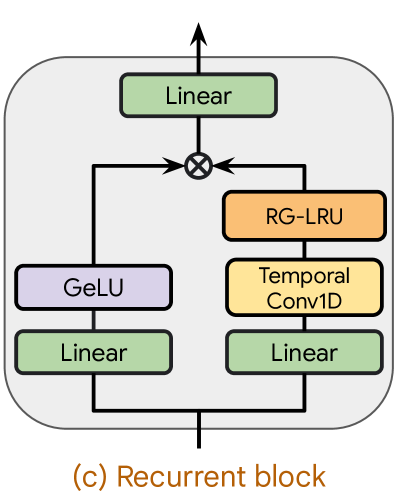
含遞迴區塊的殘差區塊
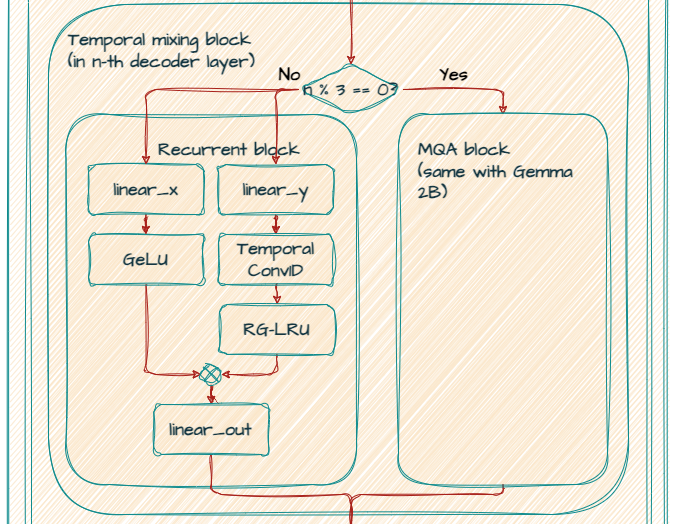
在遞迴區塊(時間混合區塊,Temporal mixing block)中,模型接受維度為 2560(模型寬度)的輸入,並並行套用兩個輸出維度為 2560(RNN 寬度)的線性層,形成兩個分支。
在第一個分支(右側),它套用一個時間濾波器維度為 4 的小型可分離 Conv1D 層,接著是 RG-LRU(Real-Gated Linear Recurrent Unit)層。
在第二個分支(左側),它套用 GeLU 非線性函數。
然後以逐元素相乘合併兩個分支,再套用最終的線性層,輸出維度為 2560(模型寬度)。
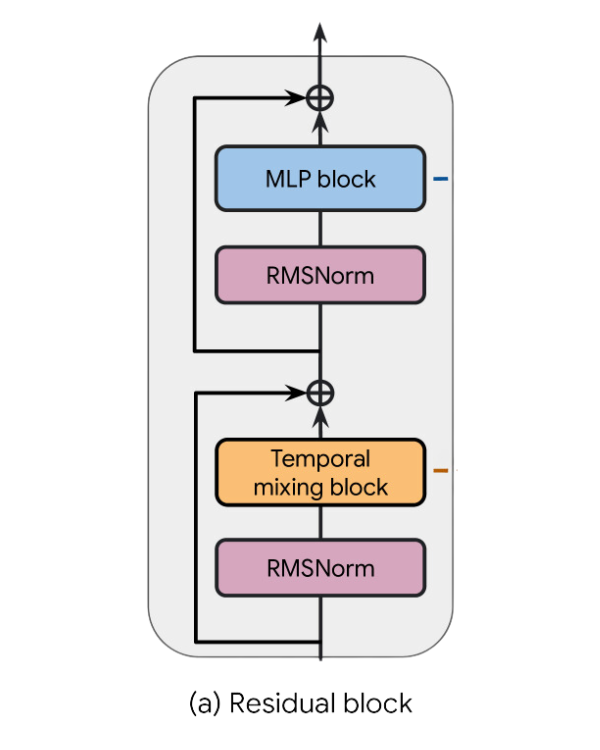
套用 RMSNorm 之後,接著是 MLP 區塊。
含區域 MQA 的殘差區塊
在兩個含遞迴區塊的殘差區塊(0-1)之後,接著是一個含區域 MQA 的殘差區塊(2)。使用全域注意力的一個主要缺點是,其計算複雜度隨序列長度二次增長。為了解決這個問題,RecurrentGemma 使用區域滑動視窗注意力,只允許每個位置關注過去固定數量的詞元。
在區域 MQA 區塊(時間混合區塊)中,模型接受維度為 2560(模型寬度)的輸入。它使用線性投影(q_proj、k_proj、v_proj、o_proj)來產生查詢、鍵、值與輸出的表示。注意 k_proj 與 v_proj 的 out_features 為 256,因為它們共用大小為 256 的同一個頭,而 q_proj 與 o_proj 並行使用 10 個頭(256 x 10 = 2560)。
它使用 rotary_emb(RecurrentGemmaRotaryEmbedding)做旋轉位置嵌入(RoPE),與基礎 Gemma 模型相同。
RMSNorm 與 MLP 區塊的套用方式與前一個殘差區塊相同。
下一步?
在這篇文章中,你認識了 RecurrentGemma。
在下一篇文章中,你將探索 PaliGemma——一個輕量的開放視覺語言模型(VLM)。
敬請期待,感謝閱讀!

參考資料
論文
程式碼範例
📋 完整的 Gemma 架構系列
- Gemma 詳解:Gemma 模型家族架構總覽
- Gemma 詳解:Gemma 2 的新變化
- Gemma 詳解:RecurrentGemma 架構
- Gemma 詳解:PaliGemma 架構
- Gemma 詳解:Gemma 3 的新變化
- Gemma 詳解:EmbeddingGemma 架構